If you do not offer a confirmed date-specific delivery service, your WooCommerce preferred delivery date question should collect a request, not an agreed arrival date. Read the field label and order acknowledgement together: does either turn the shopper’s preference into “your delivery date”?
A selectable date does not establish that you can meet it. Keep the question only if someone can review requests, respond within a defined time and resolve dates you cannot accommodate.
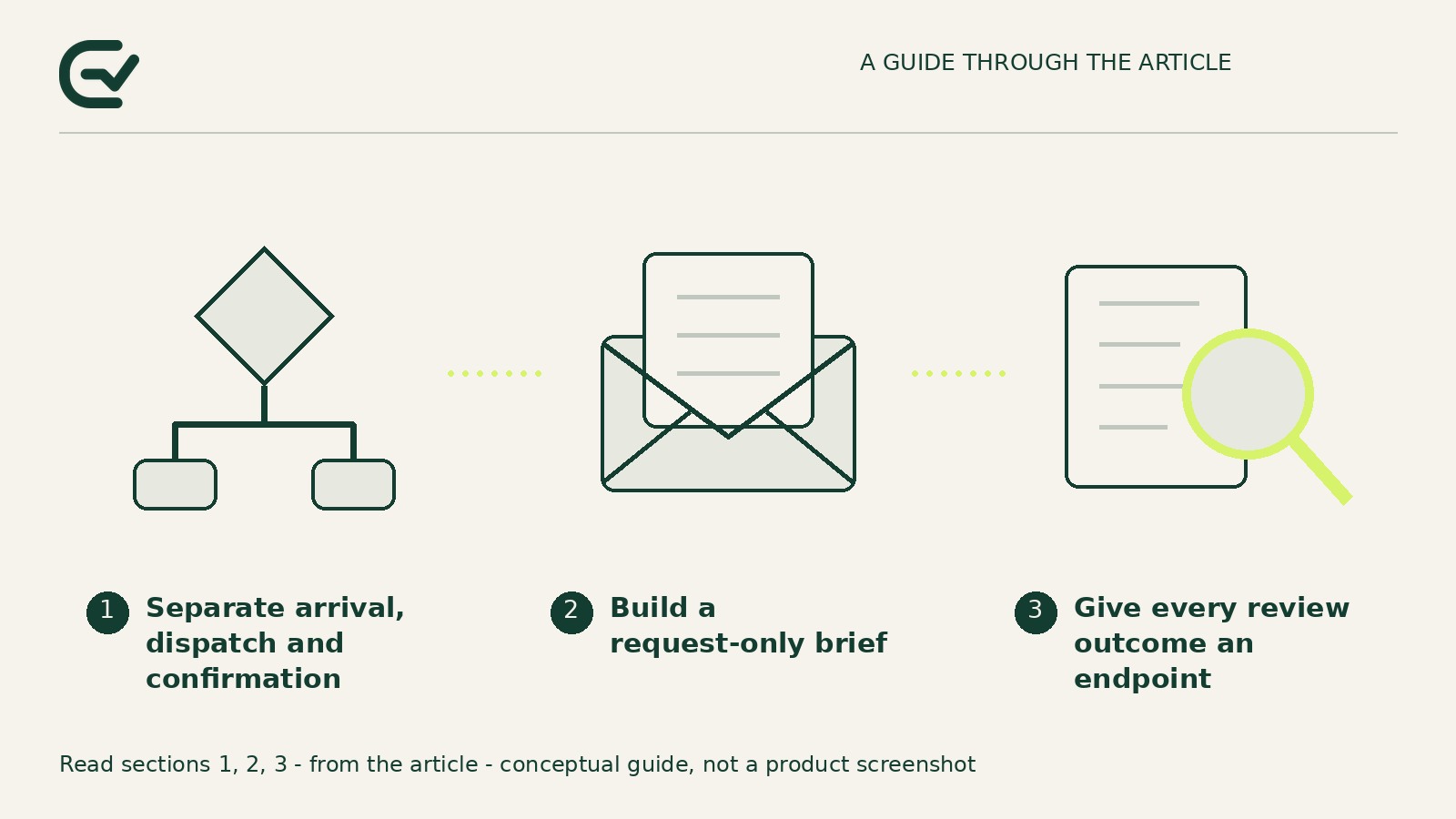
Separate arrival, dispatch and confirmation
A preferred arrival date is when the shopper wants the parcel to reach its destination. A planned dispatch date is when your team expects to hand it to the shipping service. Checkout accepting either date does not establish a delivery commitment.
Ask fulfillment staff what preparation time, dispatch options and destination-specific shipping estimates they can work with. Keep dispatch and arrival distinct in every label and message.
Calendar restrictions are not capacity reservations or carrier guarantees. Excluding weekends or allowing only later dates does not establish stock readiness, packing capacity or a suitable shipping service. Collecting a date does not itself select or reserve that service.
Build a request-only brief
Write the customer wording and staff procedure together. This brief belongs to a hypothetical store that can process ordinary orders without an arrival preference. Its staffing and deadlines are illustrative, not universal recommendations.
What the shopper sees
- Label: “Preferred arrival date (optional request).”
- Help text: “Tell us when you would prefer the parcel to arrive. This is a request, not a booking or delivery commitment. If arrival by a particular date is essential, contact us before ordering.”
- Acknowledgement when a date was supplied: “We’ve received your preferred arrival date as an unconfirmed request. We’ll email you about it by 12:00 UTC on the next working day (Monday–Friday, excluding closures listed in our ordering information).” Label any repeated date “Requested arrival date — not confirmed.”
- Acknowledgement when blank: “No preferred arrival date was requested. Your order follows our published fulfillment process.” A blank answer does not mean the shopper agreed to a particular arrival date.
Use separate acknowledgements only if you have verified that your setup can vary the message. Otherwise, use wording accurate in both cases:
“Any preferred arrival date you enter is an unconfirmed request. Orders without a date request follow our published fulfillment process.”
Place the request-review deadline and working-day definition beside that shared wording. Do not send an unconditional “request received” message when no date was supplied.
Keep the question optional because the preference is not necessary for ordinary processing. Offer pre-order contact only if someone can answer those enquiries; contact does not guarantee that a suitable service exists.
What staff must do
In this example, Morgan, the fulfillment coordinator, reviews and replies to requests. Casey, the duty manager, covers absences and owns unresolved decisions.
Orders with date requests stay out of packing until staff have reviewed and replied. If a review or reply is still outstanding at 10:00 UTC on the next working day, Casey takes over, two hours before the customer-facing deadline.
Keep infeasible or hard-deadline requests held until resolved. Define a shopper reply deadline and a final decision cutoff under the store’s stated order-handling policy.
Replace these fictional roles and timings with workable commitments. This brief does not automate messages or hold orders. Implement and verify those processes separately, whether manual or supported by your setup.
Give every review outcome an endpoint
Feasible as a preference
Record the basis for the assessment: preparation readiness, planned dispatch and the applicable shipping estimate. Tell the shopper what staff expect to do, distinguishing estimates from commitments.
“Looks feasible” is not delivery confirmation. Keep the arrival date unconfirmed unless a separate process genuinely establishes a commitment. If the shopper reveals a hard deadline, resolve that requirement before releasing the order.
Infeasible
Contact the shopper before packing. State that the requested date cannot be met, explain the supported alternative and ask for agreement on the next step.
Do not silently substitute a later date or assume permission for a paid shipping change. Explain the hold, the reply deadline and what will happen if the request remains unresolved.
Unanswered or unresolved
Distinguish three situations. No date entered follows the ordinary process. No staff review or reply completed goes to the backup at the internal cutoff; it is not permission to pack.
No shopper reply requires a final decision, not indefinite follow-ups. Set an escalation deadline and name who decides the disposition under your stated policy. Communicate that decision to the shopper. Silence is not agreement to a replacement date.
Resolve the last-minute request from start to finish
Consider the same hypothetical store receiving an order on Thursday afternoon. Friday is selectable, but the next dispatch opportunity is Monday and no alternative service can meet Friday. Assume no closures affect these dates.
Morgan replies on Friday at 09:00 UTC, ahead of both the internal cutoff and customer-facing deadline. The message explains that Friday arrival is unavailable and that Monday is the earliest dispatch opportunity, not an arrival promise. It asks for a reply by Monday at 12:00 UTC and explains that packing remains held.
Under this hypothetical store’s stated policy, Casey must resolve the order by Monday at 13:00 UTC. If the shopper agrees to proceed without the Friday deadline, staff record that agreement before release. If it remains unresolved, Casey cancels the order and communicates the cancellation and payment/refund next steps.
Cancellation is this example’s chosen disposition, not a universal rule. The important boundary is a communicated endpoint with a decision owner—not an indefinite hold or assumed consent.
Verify blank and supplied dates before retaining the question
Use a safe test environment with synthetic details and no live charge or fulfillment. Route acknowledgement emails to a controlled test inbox or mail-capture service. Inspect the checkout, saved order and acknowledgements in two cases:
- No date entered: checkout permits the blank answer, and no message invents a request or implies agreement to an arrival date.
- Friday requested: the date remains visibly requested and unconfirmed. Have the reviewer walk through the example, including backup escalation, the packing hold and final disposition.
Look for places where “requested” disappears or becomes “scheduled” or “confirmed.” Clear wording helps explain the distinction but cannot guarantee understanding.
If nobody can review requests reliably, stop collecting them and assign existing requests separately. Otherwise, save both test acknowledgements beside the brief and resolve any wording or decision gaps before retaining the question.